

Picture this: you’re standing in front of a brand-new house in Auckland, admiring the sleek lines and fresh paint. It looks rock-solid. But the real hero isn’t the roof or the walls it’s hidden metres underground, quietly doing the heavy lifting. In New Zealand, where the ground can shake, shift, or turn to soup during an earthquake, getting the foundations right isn’t just smart engineering it’s essential.
Every great building in New Zealand starts below the ground because that’s where the science of load transfer happens. The weight of the entire structure, plus everything inside it, has to be safely passed down into the soil without cracking, sinking, or tilting. Miss this step and even the most beautiful home can end up with doors that won’t close or walls that lean. Let’s walk through the basics in plain Kiwi English no jargon overload and see why house foundations New Zealand style deserve more attention than most people give them.
Why Foundations Matter More Here Than Almost Anywhere Else
New Zealand sits on the edge of two tectonic plates. Earthquakes are part of our story just ask anyone in Canterbury who lived through 2010-2011. The ground can liquefy, settle, or slide. On top of that, our soils vary wildly: volcanic ash in Auckland that’s surprisingly soft in places, heavy clay in Wellington that swells and shrinks with rain, and river silt in Christchurch that behaves like jelly in a quake.
A good foundation doesn’t just hold the house up. It spreads the load, resists sideways shaking, and keeps everything level for decades. Builders and homeowners who skip proper planning often pay later think foundation repair bills that run into tens of thousands. That’s why every new build or major renovation starts with a geotechnical report NZ basically a soil health check that tells engineers exactly what they’re dealing with before a single spade hits the dirt.
The Simple Science: How a Foundation Actually Works
Think of a foundation like the roots of a big tree. The tree (your house) needs to stay upright in wind and rain, so its roots spread wide and go deep to anchor it. Same deal with buildings.
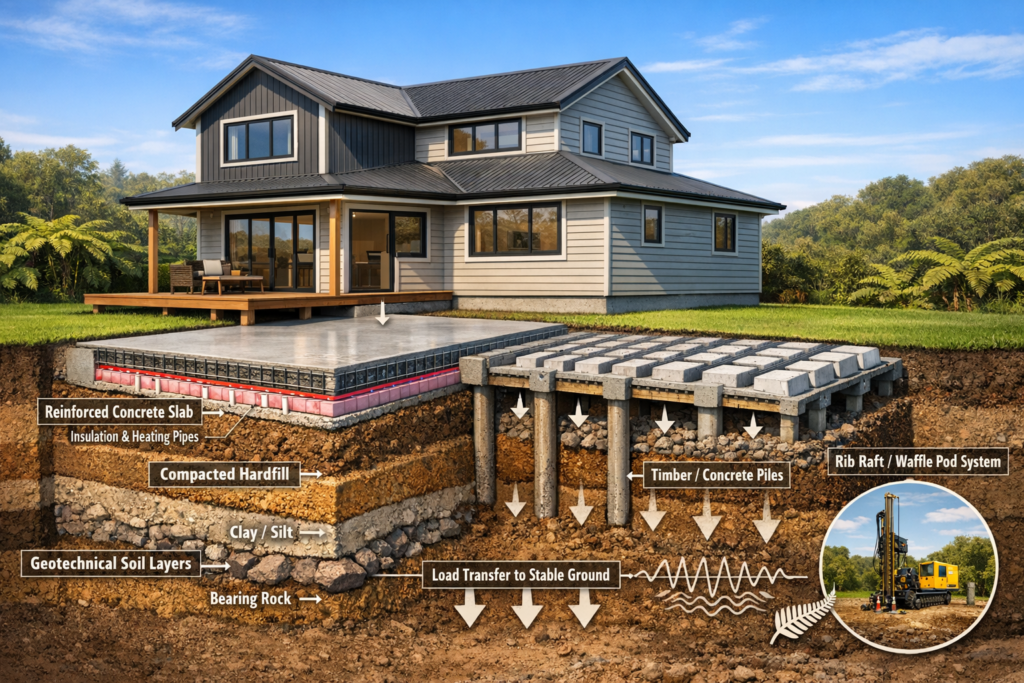
The key idea is load transfer. Every kilogram of your house timber frame, concrete roof tiles, furniture, even the people inside creates downward force. Wind and earthquakes add sideways and up-and-down forces. The foundation takes all that energy and spreads it gently into the ground so the soil doesn’t get overwhelmed and fail.
There are two main families of foundations used across New Zealand:
• Shallow foundations sit close to the surface (usually less than 3 metres deep). • Deep foundations go way down to reach stronger soil or rock.
Most Kiwi homes use one of three practical types that have been refined over decades to cope with our unique conditions.
ALSO READ: Slab Types in New Zealand Construction: Choosing the Right One for Your Project
The Three Main Types of Building Foundations NZ Uses Today
- Concrete Slab Foundations This is the most common choice for new homes on flat sites. A thick reinforced concrete pad is poured directly on prepared ground, often with extra steel mesh and insulation underneath. It’s quick, cost-effective, and acts like a single solid raft that moves as one piece during a quake. Great for: Auckland and parts of the South Island where soil is reasonably firm. Typical cost: $100–200 per square metre (including site prep). Bonus: Underfloor heating pipes can be built straight into it.
- Pile Foundations (Timber or Concrete) These are the classic “legs” you see under older homes and many modern ones on sloping or soft ground. Long piles (timber, concrete, or steel) are driven or bored deep into the soil until they hit a solid layer. Bearers and joists sit on top, creating a suspended timber floor with a crawl space underneath. Why Kiwis love them: Perfect for hilly sections in Wellington or Northland. They’re also easier to level after minor settlement. Modern twist: Many new piles are now concrete or even screw piles that spin in like giant corkscrews faster and less mess.
- Raft Foundations These are like an upgraded slab for tricky sites. A thick, heavily reinforced concrete mat covers the whole footprint and “floats” on softer ground. They’re popular in post-quake Christchurch because they can ride out liquefaction better than older designs. When to choose one: Areas with poor soil or high seismic demand. Engineers often combine them with ground improvement (like compacting or adding gravel columns) for extra strength.
Each type gets designed to meet NZS 3604 (the timber-framed buildings standard) or specific engineering for bigger projects. That standard has been battle-tested in real earthquakes and keeps getting smarter.
The Process: From Soil Test to Finished Foundation
It all starts with a geotechnical investigation. A specialist drills small holes, takes soil samples, and tests how much weight the ground can handle and how it behaves in a quake. This report becomes the bible for the rest of the build.
Next comes the design. Engineers calculate exact sizes, reinforcement, and depths. Then building consent is issued no foundation work can start without it.
On site, the crew excavates, adds compacted hardfill for drainage, places steel cages, and pours concrete. Everything is inspected before it’s covered up. One missed step here and you’re looking at costly fixes later.
What Can Go Wrong And How to Spot It Early
Even good foundations can have issues over time. Common warning signs in New Zealand homes:
• Doors and windows that suddenly stick • Cracks in concrete floors or brick veneer • Uneven floors (check with a marble or spirit level) • Gaps appearing between skirting and floor • Damp smells or mould under the house (especially with pile foundations)
If you notice any of these, get a qualified inspector in straight away. Foundation repair NZ options range from simple re-levelling jacks to full underpinning with new piles. Catching problems early saves serious money.
Cost Real Talk for Kiwi Homeowners
Foundation costs New Zealand vary hugely depending on site, size, and type. A standard 150 m² concrete slab might set you back $15,000–$30,000. Pile foundations on a slope can easily double that because of extra engineering and access. Always budget 10–15% extra for surprises New Zealand soil loves to throw curveballs.
Pro tip: Spending a bit more upfront on a proper geotechnical report and engineered design almost always pays off in the long run. Cheap foundations are expensive foundations in disguise.
Looking Ahead: Smarter, Greener Foundations
The industry is evolving fast. Screw piles and prefabricated systems are cutting waste and time. Some engineers are testing “resilient” designs that let the house rock gently in a quake then return to level. Recycled materials and lower-carbon concrete are making foundations more sustainable too.
For anyone planning a new build or renovation, the message is simple: don’t treat the foundation as an afterthought. It’s the single biggest factor in how long your home will stand tall and safe.
Next time you drive past a construction site and see workers digging deep or pouring that first slab, give them a mental high-five. They’re doing the most important job on the whole project building the part nobody will ever see but everyone will rely on.
Whether you’re in Auckland, Wellington, Christchurch, or anywhere in between, a strong foundation isn’t just good engineering. It’s peace of mind for your family, your wallet, and the next generation of Kiwis who’ll call that house home.
