

New Zealand’s construction landscape is changing faster than ever. Rising demand for housing, increasing pressure on project timelines, persistent labour shortages and escalating material costs have forced the industry to rethink how buildings are delivered. In the middle of this shift, one approach is standing out as a genuine industry game-changer: prefab and modular construction.
This is not a trend or a passing experiment. It is a structural shift in how buildings are designed, manufactured and assembled across the country. And it is reshaping expectations from developers, builders, architects and homeowners alike.
Prefab is not just about building quicker. It is about building smarter.
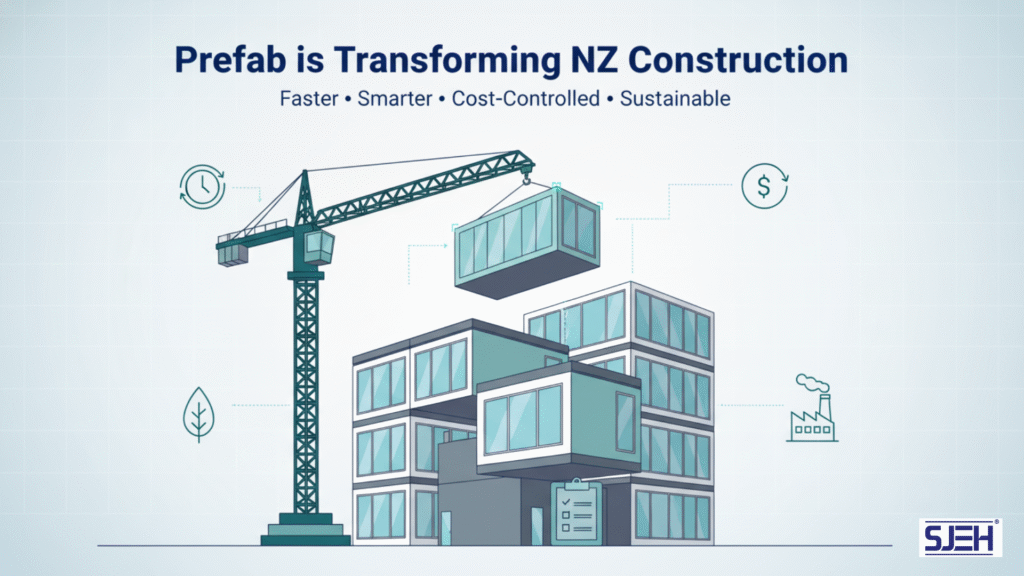
What is Prefab or Modular Construction
Prefab construction involves manufacturing building components or entire sections off-site in controlled facilities. These modules are then transported to the building site and assembled like perfectly engineered blocks. Where traditional building relies heavily on labour and weather conditions, prefab moves the complexity indoors and treats construction like precision engineering.
Think of it as building a structure the way cars are manufactured. Predictable, repeatable, efficient and quality assured.
Why New Zealand Needs Prefab Now More Than Ever
New Zealand’s construction environment is at a crossroads. The pressures are well known across the industry.
- Shortage of skilled trades continues to delay projects
- Material prices remain volatile
- Housing demand significantly outweighs supply
- Weather-dependent construction slows progress across seasons
- Labour and compliance costs keep rising
- Quality control is inconsistent when working fully on-site
Prefab directly responds to all of these challenges. Instead of asking workers to do more with less, it changes the model.
The Core Advantages of Prefab Construction
Faster Project Delivery
Manufacturing modules offsite significantly reduces time on site. While foundations are being prepared, walls, floors and roof systems are already being produced. This parallel workflow compresses project timelines and speeds up delivery without sacrificing quality.
Many prefab builds achieve completion up to 30 to 40 percent faster than traditional construction.
Cost Control and Predictability
Building indoors reduces unexpected delays, weather interruptions, rework and labour blowouts. Factories operate on repeatable processes, reducing waste and improving project certainty. Developers gain clearer cost forecasting and homeowners avoid budget creep.
Cost certainty matters more than ever and prefab delivers.
Also Read: Top Construction Budgeting Mistakes to Avoid
Superior Quality Control
Factory environments have tight measurement control, quality checking and engineered testing. Precision assembly replaces on-site improvisation, meaning systems fit together cleanly and consistently. Buildings are straighter, tighter and better sealed.
This results in stronger performance, especially for insulation and airtightness.
Sustainability and Waste Reduction
Prefab production uses exactly measured materials, improving efficiency and eliminating unnecessary waste. Off-cuts are recycled more effectively and site disruption is dramatically reduced.
Less waste, less landfill, less transport movement.
Reduced Dependence on Scarce Labour
With prefab, teams require fewer hours on-site and labour is concentrated into controlled factory processes. This is a direct solution to New Zealand’s ongoing skilled labour shortage.
Instead of competing for workers that do not exist, prefab reallocates where the work is done.
Where Prefab is Thriving in New Zealand
Prefab is gaining real momentum across multiple segments of the industry.
- Social and affordable housing developments
- Multi-unit townhouse and apartment projects
- Education and healthcare builds
- Commercial and hospitality spaces
- Emergency and rapid-response housing
- High-performance energy-efficient homes
Government-led and private developments are increasingly specifying modular systems due to reliability and faster turnaround.
Real World Impact
Developers can bring product to market sooner.
Builders gain workflow efficiency and stronger project consistency.
Architects benefit from design flexibility with modular precision.
Homeowners move in faster with less disruption.
Communities see growth happen more responsibly.
Prefab removes unnecessary complexity and replaces it with engineered certainty.
Overcoming Misconceptions
Some still believe prefab homes are basic, temporary or limited in style. That perception is outdated. Today’s modular buildings are architecturally refined, structurally advanced and capable of premium design outcomes.
Modern prefab can deliver everything from luxury homes to large commercial complexes. The technology and manufacturing capability has matured dramatically.
The Future of Construction in New Zealand is Hybrid
Traditional building is not disappearing. Instead, the future lies in merging on-site craftsmanship with off-site precision. Foundations and site works will always be physical. But the components that plug into them will increasingly arrive finished, tested and ready.
The industry is shifting from building everything from scratch to assembling intelligent, engineered pieces.
What This Transformation Means for the Industry
Prefab represents a strong competitive advantage for those who move early. Builders and developers who master modular processes, digital planning and accurate cost estimation will stay ahead of the market. The speed of adoption will separate leaders from laggards.
For construction professionals, this is a moment to evolve skills and quality expectations.
For clients and homeowners, it represents faster delivery and far greater certainty.
For New Zealand, it is a pathway to addressing the housing crisis with real scale.
Final Word
Prefab is more than a construction method. It is a smarter operating model for an industry under pressure. It delivers speed without sacrificing quality, cost control without cutting corners and sustainability without compromise. New Zealand needs housing and infrastructure delivery that keeps pace with demand. Prefab is proving it can.
The question is no longer if prefab will reshape construction in New Zealand. The question is who will adapt soon enough to lead the change.
The future of building here is modular, efficient and engineered for performance. And that future is already underway.
