

Imagine waking up in Auckland next year, scrolling through your feed, and seeing another round of headlines about families priced out of their dream homes. It’s not just a bad dream, it’s the reality staring us down as we head into 2026. But here’s the good news: AI modular construction NZ is quietly revolutionizing how we build, turning this nightmare into an opportunity. These smart, factory-built homes aren’t some distant sci-fi idea; they’re here now, using artificial intelligence to optimize designs, cut waste, and deliver results faster than you can say “consenting delays.” In a city where the average new home construction cost Auckland is pushing towards $1 million, this approach promises real relief. Let’s dive into the chaos unfolding and how you can beat it.
The Perfect Storm: Why Auckland’s Housing Market Feels Like It’s Cracking Under Pressure
Auckland has always been New Zealand’s beating heart, the place where jobs, beaches, and that unbeatable vibe draw people in. But right now, it’s choking on its own success. The Auckland housing crisis isn’t new, but as we wrap up 2025, it’s hitting fever pitch. Building consents are up 6.8% year-on-year in the region, a bright spot amid the gloom, yet the overall cost to build house Auckland keeps climbing, leaving everyday Kiwis wondering if homeownership is slipping away for good. Forecasts from experts like Cotality point to a modest 4% national house price lift in 2026, but in Auckland, supply lags demand so badly that even flat trends feel like a win.
At the core of this mess? Surging building costs Auckland 2026 projections show no mercy. The Cordell Construction Cost Index pegs a standard single-storey brick-and-tile home at around $3,500 per square meter, up 0.4% in the last quarter alone. For a 150-230m² family pad, that’s easily $525,000 to $800,000 before you even touch the land. And it’s not just inflation nibbling at the edges, it’s a full-on bite from key materials. Take timber prices NZ: they’ve jumped 5.2% in the November quarter, the sharpest rise in ages, thanks to global supply hiccups and local mill pressures. Structural timber cost NZ is now a principal villain, pushing up everything from framing to flooring. Cladding systems aren’t far behind, up 5%, while concrete edges in at 4.5%. If you’re sketching out house building plans Auckland, factor in these hikes early, or watch your budget balloon.
But costs alone don’t tell the full story. Enter immigration housing NZ dynamics, where the influx of newcomers is both a boon and a burden. Net migration hit 13,066 in the year to July 2025, but projections for 2026 suggest a rebound to 400,000 over the medium term, with Auckland absorbing the lion’s share. That’s immigration driven population growth Auckland cranking demand by 20%, per BCICentral analysis, while housing stock grows at a measly 3% annually. No wonder housing affordability Auckland feels like a pipe dream, median prices sit at 17.2 times household income, the worst in the country. On X, the chatter is raw: one user vented about how “500,000 immigrants settled mainly in Auckland,” kickstarting the crisis back in the Key era, and it’s echoing today with posts blaming migrant waves for ghost towers and stalled projects. Economic refugees NZ housing adds another layer, folks fleeing high costs elsewhere pile into the city, spiking rents 3.1% despite a 23.6% jump in listings.
This isn’t abstract econ-speak; it’s families squeezing into rentals, young couples postponing kids, and builders scratching heads over how to keep up. The Auckland housing shortage immigrants exacerbate? It’s real, with a 54,000-unit gap staring us down. Migration house price increase Auckland could push values another 8% if unchecked, per Stuff reports. And the housing crisis blame immigration NZ? It’s a hot debate on platforms like Reddit, where threads dissect how net migration effects NZ strain resources from water to roads. Upzoning Auckland immigration might ease it, but without faster builds, we’re just kicking the can.
Tie it all together, and you’ve got a feedback loop: higher demand from immigration housing NZ jacks up costs, which delays projects, which worsens the shortage. It’s why custom home builder Auckland firms are busier than ever, yet delivery times stretch to 12-18 months. How much to build a house in Auckland? Start budgeting $950,000-$1.4M for a solid three-bedder, but add 15% for overruns. Auckland new build costs 2025 already feel outdated, 2026 will test our resolve.
Also Read: NZ Infrastructure Pipeline 2026: Boom Ahead
Unseen Pitfalls: The Hidden Costs That Turn Dreams into Nightmares
Just when you think you’ve nailed the big-ticket items, the devil hides in the details. Site preparation costs Auckland can blindside you, think $50,000-$100,000 for clearing, grading, and soil tests in a hilly suburb like Remuera. Then come consent costs Auckland house build: fees have ticked up 10% with council backlogs, averaging $10,000-$20,000 per project. Delays here alone add 15% to your timeline, per Master Builders surveys.
Domestic price of timber NZ volatility? It’s not just the headline 5.2% surge, fluctuations in laminated timber prices 2025 (down 0.8% oddly, but spotty) mean locking in suppliers early is key. Carpentry costs NZ 2026 could rise another 3% with labor shortages, blending materials and manpower into a $100,000 line item. Forestry exports impact timber prices? Absolutely, overseas demand pulls supply away, leaving locals high and dry.
Worse still are the traps builders might gloss over. Cost overruns Auckland timber 2026? They’re rampant, with 72% of projects blowing budgets by 10-20%. Lien scams lurk too, think shady subcontractors slapping holds on your title, like the infamous Seascape ghost tower saga that’s still haunting X feeds. Mental health takes a hit amid the stress, with RNZ reporting deepening builder burnout. Insolvencies tick up despite optimism, per InfraNews, as small firms buckle under pressure.
- Quick Trap-Busters:
- Get a fixed-price contract upfront to cap overruns.
- Use BIM tech for 15% faster consenting, KPMG swears by it.
- Vet subs rigorously; check references to dodge liens.
These pitfalls connect back to the bigger crunch: when immigration floods the market homes, every delay amplifies the pain. Hidden costs building Auckland immigrants? They hit newcomers hardest, turning fresh starts into financial quagmires.
The Game-Changer: How AI Modular Construction NZ Delivers 30% Savings and Sanity
Enough doom-scrolling, let’s flip the script. Enter modular homes Auckland, where factory precision meets on-site speed. These aren’t cookie-cutter boxes; they’re customizable gems slashing build times by 40% and costs by up to 19%, per BRANZ research. Modular home cost Auckland? $100K-$500K for a starter, versus $420K traditional that’s $84,000 saved on a 120m² pad.
But the real magic? AI modular construction NZ trends 2025 are exploding. Tools like robotics from Silca Systems optimize layouts, predict material needs, and integrate smart features, think 3D-printed elements for quake-proofing. Prefab construction NZ 2025 is up 50% in adoption, blending off-site efficiency with on-site tweaks for sustainable modular homes NZ. Smart modular buildings NZ use IoT for energy smarts, tying into net-zero grants worth $1B.
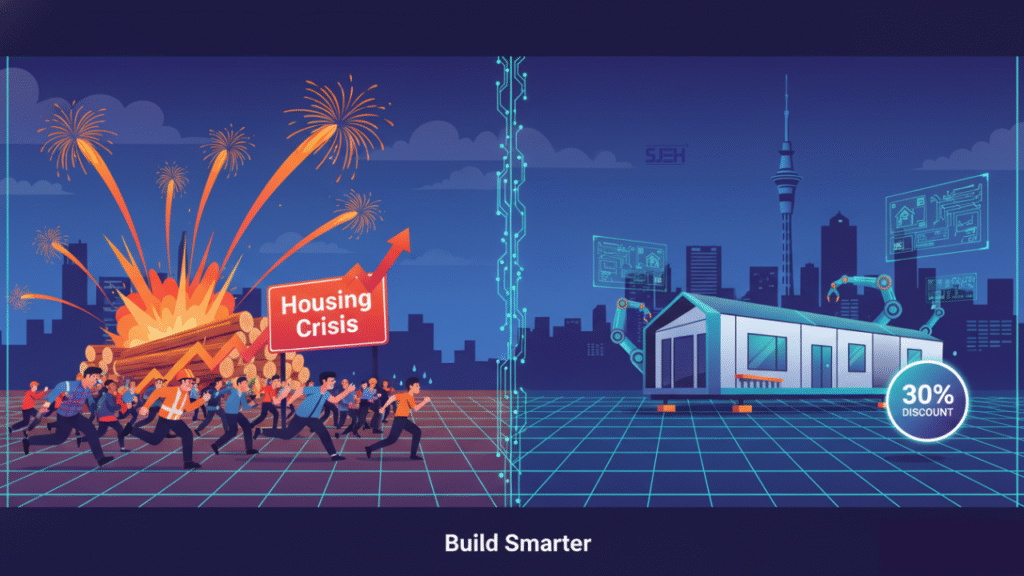
Why does this crush the crisis? Modular homes cost savings Auckland hit 30% through less waste (50% cut via AI) and labor (fewer on-site hours). Custom modular builder Auckland firms like Supersub deliver in 3-6 months, dodging timber surge migrant boom Auckland pitfalls. AI construction trends NZ 2026? Expect robotics handling 40% of assembly, per Elevate reports.
- ROI Breakdown for a 3-Bed Modular:
- Traditional: $420,000 (time: 12 months).
- AI Modular: $294,000 (time: 4 months) $126,000 saved, plus lower holding costs.
- Eco Perks: Solar tie-ins qualify for $20K grants; softened water pre-build avoids $10K fixes.
Prefab duplex Auckland cost? Under $600K for two units, perfect for multi-gen families amid the crunch. Housing crisis modular fix NZ? It’s proven, Austin’s 3D-printed boom dropped prices 28%. Immigrants flooding Auckland market homes get a fair shot too, with community co-ops saving 25% via bulk modular kits. AI optimized modular kits NZ like WasteXpert’s are game-changers, recycling scraps into strength.
This isn’t hype; it’s happening. Prefabricated homes NZ lead the charge, with 77% prefab content yielding 40-120% better schedules in Kiwi projects. Sustainable modular homes NZ align with 2030 renewables, making them future-proof.
Your Roadmap: From Vision to Keys in Hand
Ready to act? Start with a step-by-step guide to building a house in Auckland via modular magic.
- Plan Smart: Sketch house building plans Auckland with AI tools, free apps simulate costs.
- Budget Real: Use an Auckland build budget calculator 2026; aim $350K for modular vs. $500K traditional.
- Source Right: Partner with prefab pros for modular homes cost Nelson tweaks if expanding regions.
- Consent Quick: BIM shaves weeks; expect $15K total.
- Build & Move: 3-phase solar tie-ins for grants; community co-ops vs. solo builds save big in Otago models.
Hidden costs? Minimal, modular dodges most.
Seize the Rebound: Build Smarter in 2026
Auckland’s buildpocalypse is real, but it’s not inevitable. Timber prices NZ exploding and immigration housing NZ pressures are squeezing us, but AI modular construction NZ offers a lifeline, 30% cheaper, faster, and greener. Don’t wait for prices to spike; lock in now and turn the tide. Download our free Auckland build budget calculator today, or chat with a custom modular builder Auckland. Your home awaits, affordable, innovative, and yours.
