

When planning a new home or small commercial building in New Zealand, the concrete slab is one of the most important early decisions. It forms the base of everything that follows. With our seismic risks, varied soils, and strict Building Code requirements, the right choice can improve safety, cut costs, and speed up construction.
Concrete slab floors are now the most common ground floor system in New Zealand homes. The decision between types depends on site conditions, budget, and performance needs under Clause B1 (Structure) and H1 (Energy Efficiency).
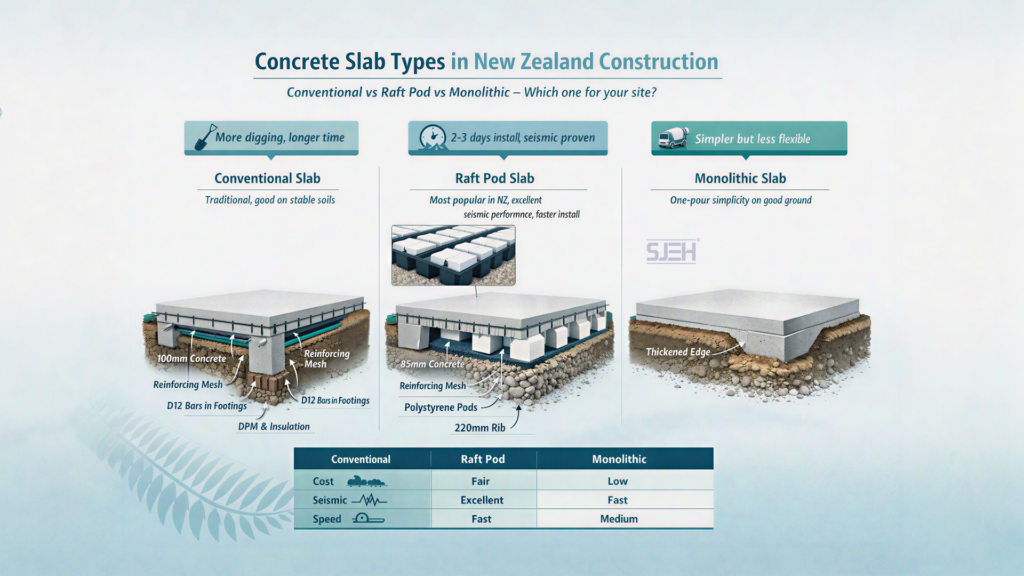
Why Slab Type Matters Here
New Zealand’s earthquake history, especially the Canterbury earthquakes, showed that some older slab designs cracked or shifted. Modern systems focus on stiffness, lightness, and even load distribution. Raft-style slabs proved stronger in liquefaction zones because they sit on the ground rather than being locked into it. Insulation rules under H1 also require careful edge and under-slab detailing to meet R-values in different climate zones.
Main Slab Types Used in New Zealand
1. Conventional Slab (NZS 3604) This is the traditional option with perimeter and internal footings dug into the ground, then a 100 mm topping slab poured on top. It works well on stable, good-bearing soils and follows the standard timber-framed house rules. Drawbacks include more excavation, longer build time, and less flexibility on reactive or liquefaction-prone sites.
2. Raft Pod Slab Systems (RibRaft, SuperSlab, QPOD) These above-ground “floating” systems are now the most popular choice for residential and light commercial projects. Polystyrene or plastic pods create a grid of reinforced concrete ribs with a thin topping slab. Key advantages:
- Excellent seismic performance – proven in Christchurch earthquakes
- Less concrete and lighter weight
- Faster installation (often 2–3 days)
- Better thermal performance when combined with edge insulation
- Often Code Mark approved, so no specific engineering design needed on many sites
Systems like Firth RibRaft and Allied Concrete SuperSlab are widely used from Auckland to Otago.
Also Read: Estimator-Builder Collaboration Boosts Delivery
3. Monolithic Slab Footing and slab poured in one go. It is simpler than conventional but still requires good ground preparation.
4. Suspended Slabs (for upper floors) Precast hollow-core units or cast-in-place slabs are common in multi-storey residential and commercial buildings. Note: Post-2011 and 2022 updates to NZS 3101 require stronger seismic connections and seating details for hollow-core floors.
Quick Guide to Choosing
- Stable soil, budget project → Conventional slab
- Seismic zone, reactive soil, speed needed → Raft pod system (most common today)
- Multi-storey or long spans → Post-tensioned or hollow-core suspended
- Energy efficiency focus → Add under-slab or edge insulation to meet H1 tables
Always check your site’s TC (Technical Category) rating and talk to a structural engineer early. A small upfront cost for the right design can prevent much larger problems later.
The right slab delivers a stronger, warmer, and more resilient building. Many teams across the country now default to raft pod systems for good reason.
Which slab type have you specified on recent projects? Share your experience in the comments – it helps the whole industry.
