

Picture this: It’s a crisp Auckland morning in early 2023, and Sarah, a young family settling into her new coastal home in Piha, wakes up to the sound of waves crashing closer than ever before. What was once a dreamy beachside retreat now feels precarious. Heavy rains from ex-tropical cyclones have eroded the dunes, and whispers of rising sea levels from her local council meetings keep her up at night. Sarah isn’t alone. Across New Zealand, from the flood-prone flats of the Waikato to the wildfire-risk ridges of the Coromandel, homeowners and builders are grappling with a reality that’s reshaping everything about how we live and construct our spaces. Climate change isn’t some far-off headline anymore; it’s forcing us to rethink the very foundations of our homes.
As temperatures climb, storms intensify, and seas encroach, the push for climate resilient homes in New Zealand has never been more urgent. For developers, builders, and even policymakers, this shift means moving beyond traditional timber frames and leaky builds to innovative, sustainable home building practices in NZ that stand up to tomorrow’s weather. Drawing from the latest reports by NIWA, BRANZ, and the Ministry of Business, Innovation and Employment, this piece dives into the challenges we’re facing and the smart adaptations turning vulnerability into strength. It’s a story of evolution, one brick and beam at a time.
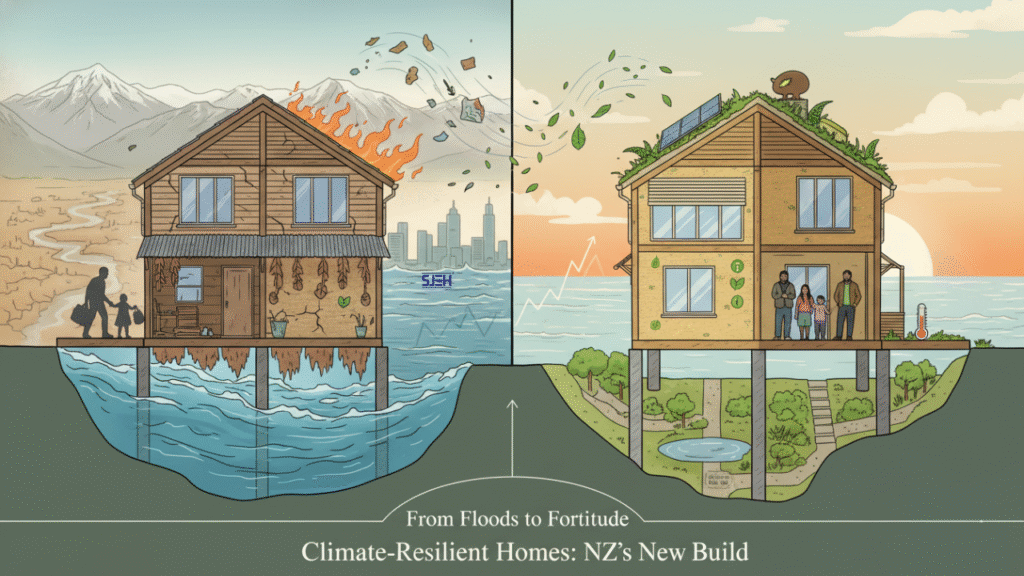
The Growing Threats: Why New Zealand Homes Are at Risk
New Zealand’s unique geography makes it a frontline for climate impacts. Nestled between ocean and mountains, our islands are warming faster than the global average, with NIWA projecting up to a metre of sea-level rise by century’s end. That’s not just numbers on a chart; it’s homes like Sarah’s teetering on the edge.
Let’s break down the big hitters:
- Flooding and Coastal Squeeze: Heavy downpours and storm surges are hitting harder. In the West Coast of the South Island, rainfall could jump 20 percent, swelling rivers and overwhelming stormwater systems. Meanwhile, around 9,000 homes sit less than half a metre above high tide, with another 43,000 vulnerable to erosion. The 2017 Edgecumbe floods left over 500 homes uninhabitable for months, contaminated by sewage and silt.
- Heatwaves and Overheating: Summers are scorching up, with heatwaves becoming routine. Warmer winters mean less snowpack for water supplies, but indoors, it’s a different story. Poorly insulated homes trap humidity, breeding mould and degrading materials like plastics and coatings.
- Fiercer Winds and Storms: Gusts in wind zones like Wellington could spike, ripping off roofs and shattering windows. Ex-tropical cyclones, once rare, now barrel through more often, testing the limits of our lightweight timber builds.
- Droughts and Wildfires: Eastern regions face drier spells, raising fire risks. Smoke from blazes in the Nelson-Tasman area not only chokes air quality but also infiltrates homes, harming health.
These aren’t isolated events; they’re interconnected. For homeowners, the fallout includes skyrocketing insurance premiums or outright denials, as rising seas are reclassified as predictable risks. Developers see project delays, and builders contend with material shortages from disrupted supply chains. The National Climate Change Risk Assessment paints a stark picture: without action, our built environment could cost billions in repairs by 2050.
The core problem? Many of our existing homes, built to yesterday’s code, just aren’t equipped. Substandard insulation and flood-vulnerable foundations amplify every storm. But here’s the silver lining: we’re not starting from scratch. New Zealand’s Building Code is evolving, and with it, a wave of climate change adaptation housing strategies that’s making our abodes tougher and greener.
Also Read: Construction Labour Shortage NZ: 2025 Industry Impact
From Reactive Fixes to Proactive Designs: Key Shifts in Home Building
It’s fascinating how necessity sparks ingenuity. Take the Building for Climate Change programme from MBIE, launched to slash emissions and boost resilience. This isn’t about slapping on solar panels; it’s a holistic overhaul. Builders are now embedding resilience into every stage, from site selection to final handover.
Consider passive design in NZ, a cornerstone of these changes. By orienting homes to capture winter sun while shading summer heat, we’re cutting reliance on air conditioning by up to 70 percent in some prototypes. It’s simple physics meeting smart architecture.
Here’s how problem-solution pairs are playing out on the ground:
- Problem: Flood-Prone Foundations Leading to Total Losses Solution: Elevate new builds on piers or fill in high-risk zones, paired with permeable paving to let water soak away. The Resilient Homes Flooding Guide recommends waterproof membranes and raised electricals, turning potential disasters into minor inconveniences. In Hamilton, developers are now mandatory-reporting flood risks via updated Land Information Memoranda, effective July 2025.
- Problem: Sweltering Interiors from Rising TempsSolution: High-performance envelopes with double or triple glazing, plus thermal mass like concrete floors to absorb daytime heat. The Higher Temperatures Guide pushes for ceiling fans and cross-ventilation, keeping homes cool without cranking the power bill. Hempcrete walls, a low-carbon mix of hemp and lime, are gaining traction for their insulating and fire-resistant perks.
- Problem: Wind Damage Tearing Through Lightweight StructuresSolution: Reinforce with wind-rated fixings and flexible cladding. In cyclone-vulnerable areas, modular prefabricated panels snap together faster and stronger, reducing on-site waste by 90 percent. BRANZ advises securing older roofs with additional ties, a retrofit that’s saved structures in recent gales.
- Problem: Wildfire Smoke and Spark IgnitionSolution: Ember-resistant screens on vents and non-combustible materials like fibre cement siding. The Droughts and Wildfires Guide highlights defensible spaces around homes, clearing vegetation to create fire breaks. Kainga Ora’s urban developments now integrate these from the blueprint stage.
These aren’t pie-in-the-sky ideas. The Aotearoa New Zealand’s First National Adaptation Plan, rolled out in 2022, mandates reviewing regulations to future-proof housing. Certifications like Homestar are becoming the gold standard, rating homes on resilience alongside energy efficiency.
Real Stories from the Frontlines: Builders Leading the Charge
Nothing illustrates this shift like the voices on the job site. Meet Tom, a Christchurch builder who’s ditched standard pine framing for certified sustainable timber from FSC forests. “After the quakes, we learned about shakes,” he says with a chuckle, “but climate’s teaching us about swells and scorches.” Tom’s crew just wrapped a low-carbon home in Rolleston using recycled plastic for insulation batts and low-emission concrete blended with fly ash. The result? A net-zero ready dwelling that withstood a freak hailstorm without a scratch.
Or consider the team at a Wānaka eco-subdivision. Facing drought risks, they opted for green roofs planted with native sedges, which not only sequester carbon but also cool the building by 5 degrees Celsius on hot days. Homeowners report bills halved, and the lush coverings double as stormwater sponges during deluges.
Even retrofits are booming. In Dunedin, where older Victorian homes dot the hills, councils are incentivizing upgrades with grants for airtight seals and solar hot water. One family transformed their draughty villa into a passive house, slashing heating needs by 80 percent. These tales aren’t outliers; they’re the new normal, backed by the New Zealand Green Building Council pushing for zero-carbon new builds by 2030.
Challenges persist, sure. Upfront costs can sting, hovering 10-15 percent higher for resilient features, and skilled trades are in short supply. Yet, as Tom puts it, “Pay now or pay later. I’d rather invest in a home that hugs back against the wind.”
The Payoffs: Healthier Homes, Lighter Footprints, Stronger Communities
Why bother with all this? The benefits stack up like a well-packed toolkit. First, resilience means fewer insurance heartaches; policies are stabilizing for compliant builds. Second, sustainable practices slash operational emissions, with efficient homes using half the energy of older ones. Imagine saving $40 billion nationwide by 2050 through avoided damages and efficiencies.
Health wins big too. Better ventilation curbs mould, reducing respiratory issues that plague one in five Kiwi kids. Indoor air stays fresh, temperatures steady, fostering spaces where families thrive, not just survive.
Economically, it’s a boon. Jobs in green construction are surging, from hempcrete mixers to BIM modellers. Developers gain a competitive edge, marketing “climate-proof” abodes that attract eco-savvy buyers. And communities? They’re tighter, with shared green spaces and managed retreats preserving coastlines for future generations.
In essence, these changes foster low-carbon homes in NZ that align with our Paris Agreement pledges, turning individual homes into collective shields against the storm.
Looking Ahead: A Resilient Future Beckons
As we hit 2025, momentum is building. The Building Code’s next refresh will weave in embodied carbon limits, and tools like the BRANZ Climate Change Hub are arming builders with free resources. But success hinges on collaboration: governments fast-tracking consents, industry upskilling via apprenticeships, and homeowners demanding better.
Sarah’s story? She’s retrofitting now, adding flood barriers and solar shades. “It’s scary, but empowering,” she shares. “Our home’s evolving with the planet.”
If you’re a developer eyeing that next subdivision or a builder scouting sustainable suppliers, the time to act is today. Dive into the Resilient Homes guides or connect with the NZGBC for tailored advice. Let’s build not just houses, but havens that weather whatever comes. What’s your next step in this climate-smart journey?
