

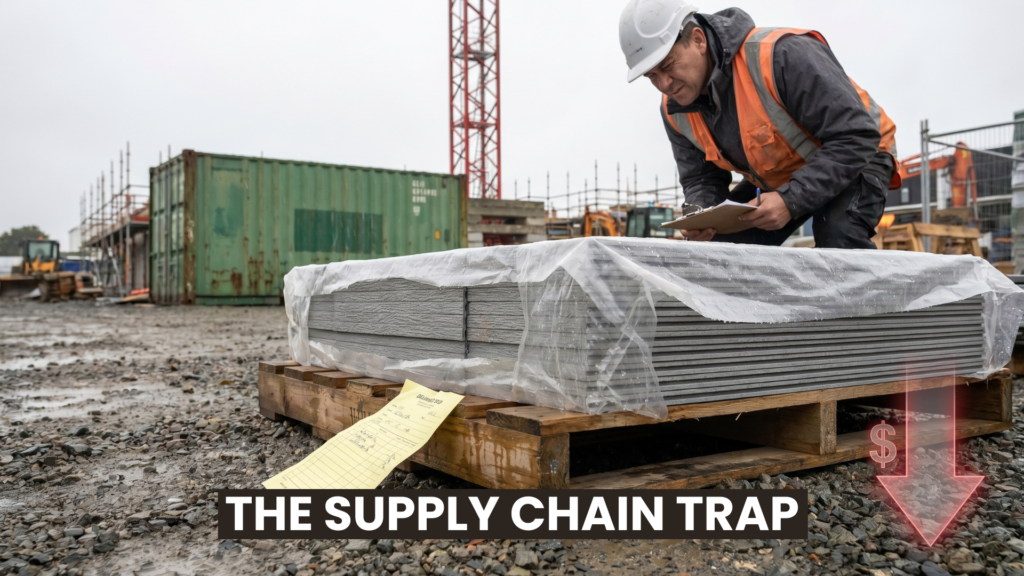
A mid-sized contractor in Hamilton learned a hard lesson earlier this year. The project had been priced confidently. Margins looked healthy on paper. The site team was ready. Then came the delivery call that changed everything. The imported cladding system, originally quoted with an 8-week lead time, had quietly stretched to 14 weeks. The alternative local product cost 18 percent more. Freight charges had also crept up since the original quote. Before a single fixing was installed, the margin had already shrunk by three percent.
That story is not an exception. Across New Zealand, similar supply chain surprises are quietly eating into project profits. The extreme disruption of 2022 and 2023 has faded, but the construction supply chain has not returned to its old predictable rhythm. It has settled into a new normal where timing, currency, and material availability demand attention long before ground is broken. Builders and project managers who treat procurement as an early strategic step are protecting their margins. Those who leave it as a last-minute formality are paying the price.
This article explains why supply chain risk management is the single most effective margin protection tool available to New Zealand construction businesses right now, and how a simple shift in procurement timing can make all the difference.
Why Supply Chain Pain Is Still Real in 2026
The global shipping crisis and pandemic shortages have ended, but new pressures have taken their place. The New Zealand construction sector remains heavily reliant on imported materials. Structural steel, specialty cladding, high-spec glazing, mechanical components, and even certain engineered timber products still travel long distances before reaching a local site.
Several factors are keeping the pressure on:
- Longer manufacturing cycles in Europe and Asia have become structural, not temporary. Factories that reduced capacity during downturns are not rushing to expand again.
- Freight route volatility continues. Geopolitical tension, fuel price spikes, and port congestion in key transshipment hubs still cause unexpected delays.
- Domestic distributor stock levels are lean. To manage their own cashflow, many local suppliers keep less buffer inventory than they did five years ago. When a spike in demand hits, the shelf empties fast.
For a builder, this means that a material that was “usually available in six weeks” may now take ten or twelve. And that gap between expectation and reality is where margins disappear.
The Lead Time Illusion
On paper, lead times look improved compared to the worst years. Supplier websites may show standard timelines that sound reasonable. Verbal assurances are often optimistic. The problem is that best-case scenarios are quoted, while real-world delivery consistently lands further out.
The items most likely to catch a project off guard right now include:
- Specialty cladding and facade systems from European and Asian manufacturers.
- High-end plumbing fixtures and fittings that are specified early in design but ordered late in construction.
- Commercial door hardware with specific fire-rating requirements.
- Engineered timber beams and panels that are gaining popularity in multi-unit residential projects.
When these materials arrive late, the damage moves far beyond the obvious delay. Other trades get pushed out. Site overhead continues. Liquidated damages or client relationship stress starts building. The programme falls apart piece by piece.
The fix is simple in concept but rarely applied with discipline: add a realistic buffer of three to four weeks on top of every quoted lead time for critical imported items. This buffer is not a sign of mistrust. It is project insurance that costs nothing.
Currency Swings: The Silent Margin Killer
The New Zealand dollar has a direct and immediate impact on construction costs. Many imported building materials are purchased in US dollars, euros, or yen. When the NZD weakens, the landed cost of those materials rises. This risk often sits quietly in the background until an invoice lands with an unpleasant number.
A product priced when the NZD was buying 0.59 US cents may look very different if the dollar drops to 0.56 before the payment is processed. On a large order, that small movement can wipe out thousands of dollars in expected profit.
Few construction contracts lock exchange rates at the quote stage. Suppliers will often hold a price for 30 days, but beyond that, currency adjustment clauses can kick in. If the procurement team delays placing an order, the cost can drift upward without anyone noticing until the monthly cost report.
Ways to manage this risk proactively:
- Ask every supplier directly whether their quote includes a fixed exchange rate or a currency fluctuation clause. Do not assume.
- Place orders for long-lead imported items as soon as the main contract is awarded. Delaying that purchase order is the most expensive form of hesitation.
- Build a small foreign exchange contingency into the project budget. Even 1.5 to 2 percent can absorb a lot of silent movement over the project lifecycle.
- Review bulk orders quarterly. A regular rhythm catches cost creep before it compounds.
This is not about speculation. It is about awareness. Currency risk sits quietly in the background until it makes a loud noise in the final account.
Also Read: House Foundations NZ: The Hidden Science Below Ground
A Smarter Procurement Approach for Every Job
The margin that survives is the one that was protected before the first excavator arrives. Shifting procurement from a reactive task to an early, deliberate process does not require new software or complex systems. It requires a change in habit.
Early procurement means identifying risk items within the first week after contract award. It means having conversations with suppliers when the ink is still drying on the contract, not when the site is being set up. It means linking the project programme to confirmed delivery dates, not assumed ones.
Here is a procurement checklist that any project team can implement immediately:
- Identify every imported material and long-lead component within two working days of contract award.
- Contact each supplier directly and get current lead times confirmed in writing. Never rely on last season’s assumptions or a website estimate.
- Negotiate a price validity period that covers the realistic programme timeline. If that is not possible, ask for a fixed escalation cap to limit upside risk.
- Place orders for critical items immediately. Even a one-week delay in issuing a purchase order can push delivery back by three or four weeks on constrained products.
- Share confirmed delivery dates with the project manager before the construction programme is finalised. A programme built around real lead times is rare but incredibly powerful.
- Set a reminder to review order status fortnightly. Supply chains shift, and the earlier a delay is spotted, the more options remain available.
The True Cost of Waiting
Consider a real scenario that has played out on several Auckland sites recently. An interior fit-out required a specific European lighting system. The spec had been signed off early in the design phase, but the purchase order was not raised until the ceiling grid was nearly complete. By then, the lead time had doubled from six weeks to twelve. The main contractor faced two choices: pay a premium for air freight, which added 22 percent to the product cost, or delay the client handover and face penalty clauses. Neither option was pleasant. Both outcomes were avoidable with a purchase order placed eight weeks earlier.
Stories like this repeat across the country. They rarely make it into industry headlines, but they are the reason some contractors consistently outperform their peers on margin.
Building Supply Chain Resilience for the Long Term
Beyond individual projects, construction businesses that treat procurement as a core capability are building a long-term competitive advantage. They are the companies that:
- Maintain a vetted list of preferred suppliers with known lead time performance.
- Track historical delivery data to improve future programme accuracy.
- Develop backup material options during the design phase, not when a delay is already active.
- Educate clients and consultants about procurement constraints early, creating shared understanding rather than late blame.
These practices do not add overhead. They reduce crisis management, rework, and relationship damage.
Summary
The New Zealand construction market in 2026 is navigating a cautious recovery. Residential consents are up, infrastructure work is growing, but commercial confidence remains fragile. In this environment, no builder can afford to bleed margin through preventable supply chain gaps.
The message is simple and practical:
- Recognise that lead times remain unpredictable for many imported products.
- Build a realistic buffer into project programmes to absorb delivery surprises.
- Lock in orders and currency exposure as early as possible.
- Make early procurement a standard discipline, not a rushed afterthought.
The cheapest insurance a construction business can buy is forward planning. Right now, in New Zealand’s quiet industry reset, it pays more than ever.
